SimHydro conferences, since 2010, have created a regular forum where major actors of the hydroinformatic domain and stakeholders meet, share and debate about needs, innovations and implementations of models and their inputs for decision making. The various sessions of SimHydro 2027 will cover these dimensions and will offer to the participants the possibility to share and exchange with scientists, practitioners and decision makers.
The SimHydro 2027 conference is jointly organized by the Société Hydrotechnique de France (SHF), the Association Française de Mécanique (AFM), the Environmental & Water Resources Institute (EWRI) and the International Association for Hydro-Environment Engineering and Research (IAHR) with the support of Polytech Nice Sophia and Université Côte d’Azur .
Following the 8 past successful events in 2010, 2012, 2014, 2017, 2019, 2021, 2023 and 2025, the next SimHydro Conference will be held from June 2 to June 4 2027 in Nice, France. The conference will run on-site only. For this new edition, the general theme of the conference will be focused on “Which models for water issues?”. The objective is to address the challenges faced by the water modelling community and to identify the efficient modelling strategies to tackle water issues. The modelling concepts used in the water sector are challenged by the availability of computational power and the surge of AI agents. Both aspects bring opportunities for disruptive approaches and emergence of new operational concepts that could fit the expectations of the water professional sector. Questioning the added value of models must be a priority for operators and modellers. The exponential production of field and monitoring data with new generation sensors (including remote sensing) is becoming a real burden for scientists, engineerings and field operators who have to define a sustainable strategy for data management for a decade horizon, optimize investments, manage maintenance and at the same time, ensure quality and reliability. Emerging concepts like Digital Twins bring answers that must be discussed among the various actors of the water sector and the solution providers as well.
In addition to the recurrent topics of the conference, SimHydro 2027 will focused sessions around the following major themes:
- Artificial Intelligence (AI) for water issues: With the availability of computational resources and real-time communication protocols, the Artificial Intelligence (AI) methods and tools are flowing within all scientific and technical sectors including the water domain. The massive deployment of those tools is obviously attracting interest of the water community as they offer the possibility to address complex problems and can potentially support real-time operations that represent a major step for many professionals engaged within operations. However, if the perspectives look promissing, the practical development and implementation requests to go through a critical and validation process that is not yet fully formalized. Based on the latest AI developments and the most recent implementations in the water domain, the plenary session will address the added value of the AI approaches and the associated challenges that should be understood by the water community.
- Digital twins: The concept digital twin is gaining interest in the water community and especially for water services as demonstrated during the two last SimHydro editions. The digital representation of assets, devices and water systems is following the SCADA deployment that has been already used for decades. The digital twins represent an integration phase that still at the early stage. The ambition to improve efficiency and performance in water service sector requests to integrate an increased complexity that is not formalized within the current scope of digital twins. Within this perspective, the deployment of the digital twin concept to catchments represents even a greater challenge. The session will address the latest developments for digital twins in the various water sectors.
- Models for extreme hydrologic events: Over the last four years, many regions of the world have faced one of the most exceptional drought events of the past 50 years. At the same time, severe convective storms and the associated flash floods are, since 2024, the most costly disasters for insurance companies. Under those exceptional circumstances, once again the need for modelling tools able to address and to anticipate this type of situation has been underlined for the development of sustainable water sharing strategies. Obviously the innovative approaches regarding waste water treatment for water reuse and recycle have gained interest and appear on the list of operational solutions. A holistic approach is called and requests efficient modelling tools. In this context, the current modelling approach needs to be updated and to integrate a wider spectrum of processes to be able to formulate proper management strategies encompassing water uses, natural environment preservation and water related hazards mitigation.
- Spatial hydrology advances for surface continental water modellers. The increasing availability of high-resolution spatial data from remote sensing, in-situ observations and numerical modelling is opening new perspectives for the representation of continental surface water systems. At the same time, advances in geospatial technologies, hydrological modelling and data-driven methods are providing new opportunities to better characterize the spatial and temporal dynamics of rivers, lakes, reservoirs, wetlands and catchments. This session will address recent advances and remanent limits in spatial hydrology and their integration into modelling frameworks for surface continental waters. Contributions are invited on innovative methods for integrating spatial information into hydrological and hydraulic models,. Particular attention will be given to methods that improve the representation of hydrological processes across scales, the characterization of spatial heterogeneity, and the interactions between surface water, terrestrial systems and human activities. Beyond methodological developments, the session will also welcome contributions addressing data assimilation, uncertainty quantification, machine learning and hybrid modelling approaches that exploit spatially distributed observations. Contributions demonstrating applications to floods, droughts, water resources, environmental monitoring or real-time management are particularly encouraged. The objective is to bring together hydrologists, hydraulic modellers, remote-sensing specialists, and practitioners to discuss how emerging spatial approaches can contribute to the next generation of surface water models and decision-support tools.
- From Sensors to Models: IoT, FAIR Data and Advances in Hydrological and Hydraulic Modelling. The rapid development of IoT technologies, low-cost sensors, remote monitoring systems and connected observation networks is opening new opportunities for hydrological and hydraulic sciences. The increasing availability of high-frequency and spatially distributed observations can contribute to a better understanding of hydrological and hydraulic processes, while providing new sources of information for model development, calibration, validation and real-time forecasting. However, exploiting these emerging data streams requires appropriate monitoring strategies, quality control, uncertainty assessment and efficient approaches for data management and interoperability. This session will focus on the integration of emerging observation technologies and data practices into hydrological and hydraulic modelling frameworks. Contributions are invited on IoT-based monitoring networks, sensor deployment strategies, real-time and high-frequency observations, data quality and uncertainty, FAIR data principles, interoperability and data assimilation. Particular attention will be given to approaches that facilitate the integration of heterogeneous observations into hydrological and hydraulic models, including distributed and semi-distributed modelling, flood forecasting, rainfall–runoff modelling, river and urban hydrodynamics, and water resources applications. The session will also provide an opportunity to share practical experiences and lessons learned from the development of monitoring systems and their integration into modelling chains. Contributions addressing how new observation capabilities can improve model parametrisation, reduce uncertainty, support model updating and enhance forecasting and decision-making are particularly welcome.
- Learning from Failures and Missed Opportunities. Hydrological and hydraulic modelling studies often provide valuable lessons not only through successful applications, but also through failures, unexpected results and missed opportunities. This session invites contributions that critically reflect on modelling experiences, including unexpected model behaviour, limitations in data or model structure, unsuccessful approaches, overlooked information, and challenges encountered when transferring models across scales or contexts. Contributions may also address how such experiences led to methodological improvements, new research questions or better modelling practices. The session aims to provide an open and constructive forum for sharing lessons learned and identifying opportunities to improve the reliability, relevance and usefulness of hydrological and hydraulic models.
- Numerical Modelling for Hydroclimatic Challenges: Mediterranean and Asian Perspectives. Numerical modelling plays a key role in understanding and addressing hydroclimatic challenges across regions with contrasting environmental and socio-economic contexts. This session will bring together modelling studies from the Mediterranean, China and Southeast Asia to compare approaches, share good practices and discuss transferable methods for representing hydroclimatic processes and extremes. Contributions are invited on hydrological and hydraulic modelling, climate impacts, floods, droughts and water resources, with particular emphasis on lessons learned from regional applications. The session will provide a forum to discuss how modelling strategies, data, tools and good practices can be shared and adapted across regions, while accounting for their specific hydroclimatic characteristics.
- Special Session Hydroinfromatics by & for young professionals. The parallel evolution of (i) hydroinformatics tools and methods, (ii) of ICT technologies, and (iii) of the training practices has significantly transformed how young professionals approach opportunities to develop and execute their training and studies. This session invites students, professionals, engineers, and researchers to share the outcomes of their recent projects and innovative practices in the field. Participants are encouraged to present their work using the format that best suits their communication goals, choosing from the following options: (A) a regular presentation (12 min presentation, full paper submission), (B) a short presentation (8 min presentation, 4 pages extended abstract submission), or (C) a poster (2 min teaser presentation). To further enhance the exchanges in this session, presenters in categories (A) and (B) are free to allocate their presentation and Q&A time flexibly within their designated time slots. Abstract submissions for this special session are open until 15th April. Authors must specify their preferred presentation format (A, B, or C) when submitting their abstracts. Convenors: Morgan Abily (Université Côte d’Azur, Géoazur, France), Olivier Delestre (Université Côte d’Azur, LJAD, France)
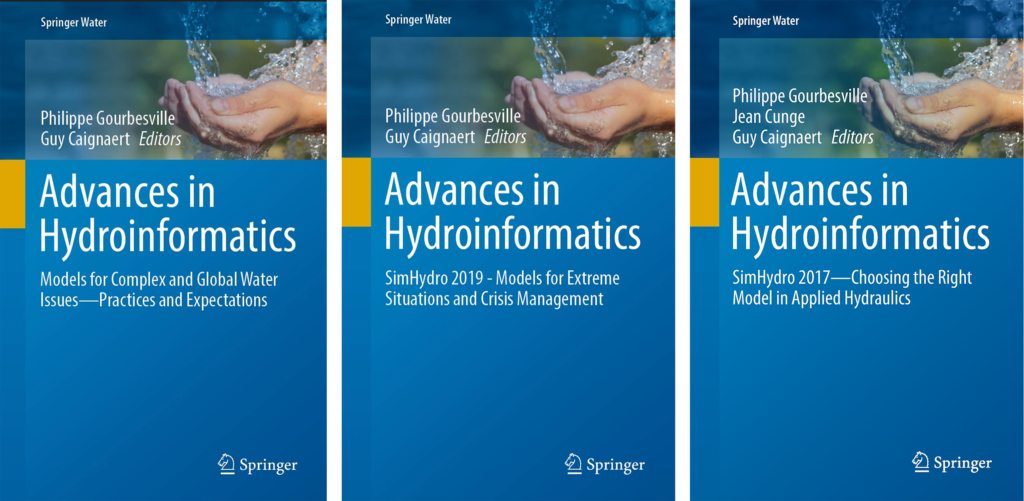
The SimHydro conference is mainly targeting the European audience and endeavours to collect high value papers that will be published in SCI scientific journals and in a specific book (Advances in Hydroinformatics) with Springer like for the 7 previous editions. Over the last 10 years, the published chapters have been downloaded more than 360 000 times. All submitted papers are going through a peer review process (2 reviews from the scientific committee) before receiving final approval for oral presentation and publication.
English will be the conference language.
Main Themes
- Models for droughts, floods and water sharing strategies
- AI for water issues
- Digital twins
- Hydro-environmental issues and extreme situations
- Uncertainties and data assimilation
- AI solutions for water
- Intensive computing for hydraulic simulations
- Extreme in hydraulics: how to deal with?
- Decision Support System and models: concepts, design, challenges, implementation and operation
- Real time management and models
- Hydraulic structures and networks: real time operation
- Scale models in hydraulics and their place and complementary in simulation concepts
- Modelling methods and tools for floods management
- 3D multi-phase flows (experiments and modelling)
- Hydraulic machinery
- Diphasic flows and cavitation
- Modelling in ecohydraulics and morphology
Keywords
Models, data, simulation, droughts, floods, water sharing strategies, water services, wastewater treatment, water reuse and recycle, AI, digital twins, uncertainties, real time, high performance computing, DSS, scale models and numerical simulation, machinery, ecohydraulics, morphology.
Scientific committee
- Aronne Armanini (Trento University – IT)
- David Fortune (University of Exeter – UK)
- D.M. Ingram (University of Edinburgh – UK)
- Christophe Coulet (BRGM – FR)
- Yann Le Coarer (INRAE – FR)
- Gislain Lipeme (INSA Lyon – FR)
- Pierre Maruzewski (EDF – DPIH – FR)
- Farid Mazzouji (Gruner Stucky – FR)
- Edie Miglio (Polytechnica di Milano – IT)
- Stéphane Mimouni (EDF – FR)
- Giorgio Pavesi (Università di Padou – IT)
- Vincent Rebour (IRSN – FR)
- Véronique Roig (IMFT – FR)
- Sébastien Roux (CNR – FR)
- Pierre Ruyer (IRSN – FR)
- Albert Ruprecht (Stuttgart University – DE)
- Patrick Sauvaget (SHF – FR)
- Rudolf Schilling (Munich University – DE)
- Anton Schleiss (EPF)L – CH)
- Théophile Terraz (INRAE – FR)
- Olivier Thual (Toulouse University – FR)
- Ezio Todini (Bologna University – IT)
- Brigitte Vinçon Leite (ENPC – FR)
- Damien Violeau (EDF-LNHE – FR)
Organizing committee
- M. Abily (Université Côte d’Azur, France)
- O. Bertrand (ARTELIA, France)
- S. Bourban (EDF, France)
- G. Caignaert (Arts et Métiers Paristech, France)
- F. X Cierco (CNR, France)
- G. De Cesare (EPFL, Switzerland))
- O. Delestre (Polytech Nice Sophia – University Côte d’Azur, France)
- O. Fouché-Grobla (Le Cnam, France)
- B. Geisseler (Geisseler Law Firm, Germany)
- Ph. Gourbesville (Polytech Nice Sophia – University Côte d’Azur, France)
- S.Y Liong (NUS, Singapore)
- C. Münch (HEVS, Switzerland)
- V.T.V Nguyen (McGill University, Canada)
- P. Tassi (EDF, France)
- P.L. Viollet (SHF, France)